Van Gogh's The Starry Night Contains Hidden Physics of Turbulence, Study Finds
A new study shows Van Gogh's 'The Starry Night' follows Kolmogorov's turbulence theory, revealing hidden physics in the iconic painting.
Art Meets Physics: The Discovery
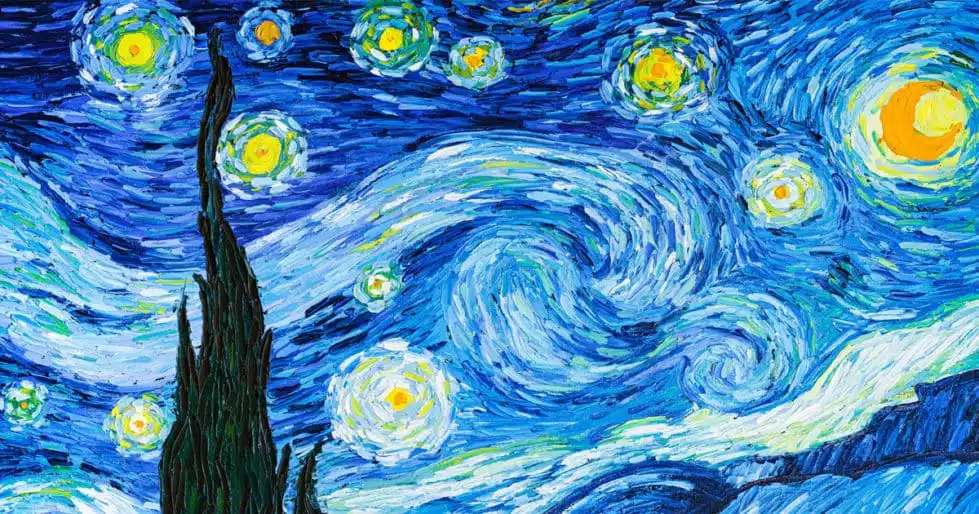
A groundbreaking study published in Physics of Fluids reveals that Vincent van Gogh's 'The Starry Night' (1889) contains a hidden mathematical structure—its swirling sky adheres to the same statistical laws that govern turbulent fluid flow. Researchers analyzing the painting's 14 main whirls found they align with both Kolmogorov's theory of turbulence and Batchelor's scaling, suggesting the artist intuitively captured physical principles centuries ahead of scientific formalization.
How Scientists Cracked the Code
Using a high-resolution digital image, the team measured the scale, luminance, and brushstroke patterns of each eddy in the painting. They compared these to Kolmogorov's 1940s cascade model, which describes how energy transfers from large to small eddies, and Batchelor's scaling, which tracks particle dispersion in turbulent flow. A key innovation was using relative brightness to infer motion within the static artwork—a technique that could be applied to other pieces.
Van Gogh's Unconscious Precision
Painted from his asylum room in Saint-Rémy-de-Provence in June 1889, just before sunrise, 'The Starry Night' reflected the artist's emotional turbulence. Yet the brushstrokes unconsciously mirrored precise mathematical behavior: the 14 swirls follow Kolmogorov's cascade at larger scales and Batchelor's dispersion at finer scales—a double alignment that surprised the research team.
Beyond Starry Night: Constable and Jupiter
To test whether this phenomenon is universal, the same analysis was applied to John Constable's 1826–27 'Chain Pier, Brighton' and a 1979 Voyager 1 image of Jupiter's Great Red Spot. Constable's clouds showed multi-scale structures, and the Jovian storm also followed Kolmogorov's theory. These results suggest that turbulent patterns are fundamental in both natural and artistic representations.
Why This Breakthrough Matters
Turbulence remains one of physics' greatest challenges, with applications from weather forecasting to aviation safety. That a static painting matches dynamic flow models indicates that current statistical tools are more powerful than assumed. This opens the door for using art to study fluid dynamics, creating a bridge between disciplines and providing accessible educational resources that make complex science visible.
Future Research and Legacy
The study encourages further interdisciplinary work: analyzing other artworks may reveal hidden patterns that refine turbulence models. 'The Starry Night,' housed at New York's Museum of Modern Art, continues to inspire. This new perspective deepens its legacy, showing that van Gogh's visionary expression reflects the very laws that shape our universe.